Today was our last full day in Thimphu and we spent it preparing for a formal speech, which we will be giving the REC in a dinner later this week. Beyond this, we were able to walk around Thimphu and go shopping in stores to buy gifts for our return home. Tomorrow we will be visiting our last school: Tenzin Higher Secondary School in the rural Paro. Wake up will be early, at 5:00am, so that we can make it to the morning prayer assembly at 8:15am. Once again, with a new school comes a completely new perspective and we will update you on exactly what new insight the students of Paro have in addition to descriptions and pictures of our stay.
Cover Photo

Wednesday, August 14, 2013


Tuesday, August 13, 2013
Update: Day 22
We spent our first full day at Pelkhil Higher Secondary School today, and it was one of the most exciting schools we have been able to visit. We joined the morning assembly where the principal let us introduce ourselves to the student body and staff of the school. Following the assembly we joined two grade twelve classes in one group of two and another group of three. Here we were able to interact with the students who, like all Bhutanese we have met, were incredibly friendly and curious about us and the U.S. The students were closer to our age and had much more exposure to American culture than students in rural schools like Tashidingkha therefore making it easier to break the ice and find similarities between ourselves. They were fans of many mainstream music artists such as Lil' Wayne, Avicii, and One Direction. During the students classes we realized they were not as attentive as students in other schools have been. The obvious reason for this was that the teachers simply did not motivate the students enough, did not try to get the students engaged in the lesson. Instead they would simply recite a few factoids about their topic and then proceed to give students a series of questions. There were some teachers that would actually attempt to educate the students but for the most part it was the way I just described: mediocre. What we did like, however, were the after school sports. It just so happened that they were preparing for some form of sports meet this Saturday and were having trials for different events. Today's consisted of the long jump, shot-put throw, and tug of war. After learning that I do jumping events for Weston High Schools Track and Field team the students were able to get me to try the long jump with them. As soon as we got to the fields it was easy to see how athletically talented these kids really were, which would also explain the multiple trophies they have in the principles office. Talking to them, we learned that two kids in the school actually played professional soccer in Bhutan: one was a starter for a National Team as well as Yeedzin F.C. and the other was a back-up goalie for Yeedzin. It was odd to think about considering we paid to see them play just two days earlier. After participating in a few athletics we sat down to enjoy our last hour with the students of Pelkhil, talking about ourselves and the hope to see each other one day again. Pelkhil will surely be a school we remember long after the end of the trip despite the fact it was only one day.
Monday, August 12, 2013
Update: Day 21
As the school week began again, so too did our rigorous
schedule as we visited Pelkhill Higher Secondary School, which marked our first
opportunity to interact with students of the same grade level as us (grade
11/12). Still, our day did not begin with prayer the way it had with
every other school we visited. Instead, we had the opportunity to attend
International Youth Day alongside many government officials (including the
education minister himself) and students of various ages. This program, which
is funded by Unicef, calls for the youth around the world to voice their
opinion about a variety of issues that directly concern them. Today, this
revolved around a discussion of the very relevant issue of youth migration. The
various students and officials who discussed this issue did so in context with
the rising tendency of the Bhutanese youth to migrate form rural Bhutan to the
more modernized urban capital city of Thimphu. This trend has amplified the
still unresolved issues of unemployment and crime in Bhutan as this increase in
population has resulted in a large body of disgruntled, unemployed, and
uneducated teens and early adults. Beyond this, issues of drugs, alcoholism,
and gang violence have surfaced as a direct result of this movement. Solutions
to these problems were discussed in an open discussion with Bhutanese officials
(including the mayor of Thimphu) and the many Bhutanese students who sat
alertly in the audience. The most common argument was that resources needed to
be more equally distributed throughout Bhutan so that the rural Bhutanese youth
could actually receive a quality education and have adequate resources and
therefore not feel the need to migrate to Thimphu to have these standards.
Beyond this, Thimphu, in ironic contrast to the rest of Bhutan, does not have
any boarding schools. As a result, students who wish to study in Thimphu are
actually forced to live there. We were all extremely interested in this
discussion and were left with many questions about what the proper solution to
this issue was. While we had no doubt that a better distribution of resources
would be helpful in limiting youth migration, some of us felt that there would
always be an incurable inclination among teens and young adults to travel to
the more lively urban centers of a country. This debate could not have come at
a better time as, shortly after the end of this event, we traveled to Pelkhill
School, a place with a history of relatively poor education standards and teen
violence and substance abuse. Even as we entered the school, we were greeted by
a student with eyes that glowed red under obvious intoxication and as we walked
through the halls of the school, it became quite clear that we were witnessing
yet another Bhutanese perspective. In the classroom itself, it seemed that the
general academic disinterest the students exhibited was met with a proportional
level of frustration, laziness, and mediocrity by the teachers. We soon learned
about the gangs that could be found throughout Thimphu, which came as a
surprise to us considering the almost unbalancing level of kindness and
generosity that we were met with. Even the students who openly admitted to
involving themselves in such activities were very a pleasure to talk with and
were, somewhat paradoxically, some of the nicest students we had met up to this
point. The question for us then became: how do these students become involved
in crime and where is Bhutanese culture in all of it? This is a question that
we will be exploring tomorrow, during our first full day at Pelkhill.
Sunday, August 11, 2013
Update: Day 20
After a late morning wake-up we were invited, by students we had befriended, to the finals of the Kings Cup, a soccer tournament that had went on for three weeks with various teams from Nepal, Bangladesh, India, and Bhutan competing for the prestigious cup. The finals were played today at 4:00 p.m. with the Bhutanese team Yeedzin F.C. playing against the Nepalese MMC. We arrived to the national stadium almost two hours early as to reserve front row seating for a better view. The seats were less than comfortable as they were simply long concrete slabs but that wasn't an issue until it started raining. Disregarding the weather however, people, mostly supporters of the Bhutanese team, began to show up in hordes decorated in red to show support for their team. Some of the more dedicated fans were covered in red face paint bringing with them drums and other percussion instruments as well as, to our amusement, conch shells in place of South Africa's vuvuzela. Right from kick-off both teams displayed an admirable amount of desire for the trophy. It was exciting to see that kind of effort within the young athletes and the excitement only rose when Yeedzin was able to put the ball in the net with a stellar header in the fourth minute. The energy from the crowd was fantastic. It did, however, dumb down a little when Nepal managed to score late in the first half. During halftime people stood up just to stretch there legs but no one wanted to leave the stadium in fear of the second half beginning without them. Returning to the game the intensity from the players was incredible, even after 45 minutes of continuous running. The game was still level but Yeedzin made the first move yet again, scoring after a little over 20 minutes into the second half. Unfortunately the joy was not long lived as the Nepalese managed a breakaway shortly after that led to a Yeedzin player scoring in his own net. With less then 20 minutes left in the game, Nepal was able to score two more goals on Bhutanese Yeedzin ending the game 4-2 in favor of Nepal. There was some obvious disappointment among the Bhutanese fans but they were proud of their men for making it to the finals in the first place. In the end, everyone had something to celebrate about regardless of which team you backed up. It was an incredible experience with many memorable moments, such as a dog running into the Nepalese goal causing Bhutanese to jump to their feet with cries of "Goal!!!", an experience we will never forget, for it is not often that the opportunity to view a Kings Cup final is presented to kids living in the U.S.
Saturday, August 10, 2013
Update: Day 19
Today, we spent a lot of time in ambient cafe, an Internet cafe, working on catching up on blog work. We ate lunch at The Zone and went back to the cafe after lunch to finish our work. We had a basketball rematch against a local team at the youth center. After honing our basketball skills in Tashidingkha, we hoped we would be able to win the game this time. Unfortunately, we lost again and ended up paying the court fee.
Update: Day 18
Today we visited the private Druk School after having arrived from Tashidingkha Middle Secondary School only one day earlier. We were told that it may not be as exciting or as great of an experience as the one we had in Phunaka due to the fact that the kids were younger than us. The visit, however, was quite incredible.
Beginning from the moment we were let in through the school gate by security, we noticed that this day would be nothing like any of the days we had spent in Tashidingka. Students were running around outside, able to do as they pleased with the time they had before any of their actual classes. The school building itself was inviting as well, painted in bright colors with large and open doors. Behind the main building was an artificial-grass soccer field where students were students were playing various sports. The campus was charming and, to an extent, reminded us of what school was like when we were children, opposed to the strictness of Tashidingkha.
We met with the principal who led us into the school for a quick tour. Some students were already in their respective classes, joking around with one another before the teacher came to class. What struck me was that some students were not wearing their traditional garb, which was required at Tashidingkha, but were instead wearing school sweatsuits which were allowed only on days when students had physical education. Passing through the hallways, we stopped by at the various science labs the school had to offer. Not to our surprise, as the rest of the school was advanced, the lab rooms were very nice. We felt as if we were shot two-hundred years into the future from Tashidingkha. Everything with Druk School was on par with our school had to offer apart from the blackboards.
The tour concluded with visits to classrooms. We split into two groups of three: one group went to grade 9, the other to grade 10. Here we sat in on the classes, observing and then afterwards talking to the students. The most obvious difference between the two schools we visited, is that students in Druk were far more confident and had much more developed English speaking skills. The entirety of the class would pay attention to the teacher speaking and ask or answer questions. It was easy to tell that these kids were slightly more knowledgable than Tashidingkha students. What was most important was that the students were happy in their classes. They were engaged and not afraid to speak up due to the fact that teacher in Druk were much less strict and often said a joke to keep kids focused rather than drone on and lose the attention of the students. It is obvious that because of the environment they are provided with, all the resources that they have, teachers and students at Druk School are able to work much more efficiently and in the end acquire more knowledge. All of this makes school enjoyable for the kids and in the end they learn more than students in schools like Tashidingka where methods of educating are very old fashioned. Students in those rural schools are more or less aware of the world modernizing, moving forward with education, yet they are stuck in what is considered the old, longing for the new. Our day at Druk school was successful as we were able to compare and contrast two different systems of education available in Bhutan and the way that kids think. We will be presenting what we learned to members of the REC later in the week.
Article: Druk School vs. Tashidinghka
Believing that all schools in Bhutan were like Tashidingkha, visiting Druk School was a pleasant surprise for me. I didn't expect such a stark contrast between the rural Tashidingkha and the urban Druk School. Everything from the students, to policies differed between the two schools. The students at Tashidingkha showed us immense hospitality and gave us their absolute attention. The students insisted on tending to our every need. I often caught students watching me from classrooms, paying more attention to me than the teacher. In rural Bhutan, the students have no concept of what America is like. The students don't have access to the Internet or TV. Many students had no idea what New York City was like. It doesn't surprise me that these students were fascinated by the Americans visiting their school. The students at Tashidingkha were very shy, especially the girls. Many girls would simply laugh at me when I greeted them. I don't remember a single girl's name from that school because they mumbled when they spoke. Even when sitting in on classes most of the students would mumble their answers. When I taught my politics class, not a single girl spoke and only half of the boys spoke. In other classes, even less of the students would speak. Druk School was the complete opposite of Tashidingkha. Druk School students are younger than Tashidingkha. Despite the age of the Druk School students, many of the students introduced themselves to me in audible and confident voices. A kid that could have been no older than 7 years old high-fived me in the hallway saying, "Hey bro, what's up?" In class, the Druk School students would shout out answers and actively take notes in class. The students were far more engaged at Druk School than they were at Tashidingkha. Although I appreciate how adamant the Tashidingkha students were about keeping us comfortable, all of the attention they gave me made me feel really uncomfortable at times. The students at Druk School had access to the Internet. Most of the students knew quite a lot about American culture. I had students ask me about whether or not I liked the band One Direction. Clearly these students had already been exposed to Western culture. They weren't mesmerized by the sight of Americans nor did they have a thousand questions about what America is like. We didn't get any special attention at Druk School but the students were absolutely friendly nonetheless. Even the teachers at Druk School were amicable like the students. The 10th grade chemistry teacher I observed would tell jokes in class and laugh along with students. The teachers at Tashidingkha were very strict. Even the some of the teachers at Tashidingkha seemed uninterested in their work. I walked in on a class at Tashidingkha and the teacher left the room so I could teach. I had nothing to teach and had no idea what to do in that situation. As I mentioned previously, the students at Druk School are far more outgoing and engaged than the students at Tashidingkha. I believe this is a direct result of strict policy. The policies at Tashidingkha are very strict. Students wake up at 5 am to do maintenance of the campus. This includes digging, sweeping, cleaning, scrubbing, planting, etc. The students are only given 15 minutes to put on their matching ghos and kiras, their school uniform. Every day the students must attend a morning assembly and an afternoon prayer. Students are not allowed to go near the dorms of the opposite sex. Relationships are forbidden. The staff openly criticized students for misbehaving. Students can be beaten for misbehaving. The students told me that the principal once slapped a student during assembly. My host family told me that only a decade back, corporal punishment was worse. Teachers abused this power and that resulted in students not showing up for class fearing punishment. I believe the strict policies at Tashidingkha causes the students to be so quiet. The students don't speak after years of being conditioned into believing that their actions will be met with punishment. I asked the students at Tashidingkha if they like the strict policies of Tashidingkha. I was surprised to hear that most of the students thought they deserved to be beaten and punished for their misbehavior. The students seemed to blindly accept the judgment of their teachers. The students liked their uniforms saying that they made everyone equal; the rich and poor had to dress equally. The students liked doing labor around the campus because they thought it taught them physical discipline. Druk School did not have such harsh punishments. The students ran around the hallways freely. Despite what some might call a lack of discipline or order, the students at Druk School struck me as well behaved. The students had as much respect for their teachers and peers as the students from Tashidingkha. I think a change in policy might be beneficial for the teachers and the students of Tashidingkha.
Article: Tashidinghka VS. Druk School
There were several differences I noticed between the two schools we’ve visited so far. There were the obvious differences like the difference in social classes and the quality of life, however when we interviewed both schools, the students of Tashidinghka decided that they liked having a school uniform where the students of Druk decided that they wanted to be able to wear whatever they wanted. The aspect of preserving culture can be observed by this result. In Tashidinghka, during morning ceremonies, there would be a morning prayer. Three times throughout the day, there would be a whistle blown that signified everyone to silently reflect or pray for about a minute. There was an hour prayer session that took place every day after school. Prayer was said before every meal. Druk, on the other hand, was a less strict place. The only prayer session that I viewed was when we were leaving. There was a 10 minute prayer session that took place, and that was all. Even when we were having lunch, the hallways were busy and no one seemed to be bowing their heads in prayer. Tashidinghka was also more removed from any major cities, as the drive from Thimpu was about an hour on an unpaved road. In Tashidinghka, a student would have to report about news once or twice every day. That made me realize any westernized ideas being spread to a rural place such as Tashidinghka would have to arrive via word of mouth from a kid that was already born into believing in the preservation of culture. There’s no doubt saying that Tashidinghka was a harsh school. Not only would a teacher berate a student if they did something wrong, but they could also hit them with a metal rod if they were acting out of line. Because the kids are brought up in such a strict environment, they aren’t given the freedom to make their own opinion on whether or not westernization is a good idea or not. Since they start school they’re taught to conduct themselves in an orderly fashion in accordance with their spiritual beliefs. Kids that go to Druk are brought up in a more loose-fitting environment where spiritual beliefs aren’t as heavily enforced. Students are presented with the pros and cons of westernization with an unbiased view and can choose for themselves if they agree with the idea or not. In my opinion, the pros of westernization heavily outweigh the cons due to the technological advancements and the ability to openly express yourself.
Photos: Days 6- 18

Julian about to deliver a speech
 |
Chefs cooking the food in Tashidingkha |
 |
| James's Art class |
 |
| Jun's Technology Class |
 |
| Creative projects at Druk School |
 |
| Model rocket in Druk School |
 |
| The remains of a creative project at Druk School |
 |
| Creative projects at Druk School |
 |
| Our team outside Phunaka Tzong |
 |
| Phunaka Tzong entrance |
 |
| One of the longest bridges in Bhutan |
 |
| Hiking in Phunaka |
 |
| At Kei and Kuba's Phunaka host family house. |
 |
| Farewell dinner in Phunaka |
 |
| Tashidingkha Soccer field |
 |
| Tashidingkha campus |
 |
| Mountains Beyond Mountains |
 |
| View on the road to Phunaka |
 |
| Dart match at Tashidingkha |
 |
| Tea time with Tashidingkha staff |
 |
| Druk School classroom |
 |
| Druk School Logo |
 |
| Tashidingkha from the distance |
 |
| Phunaka Tzong |
 |
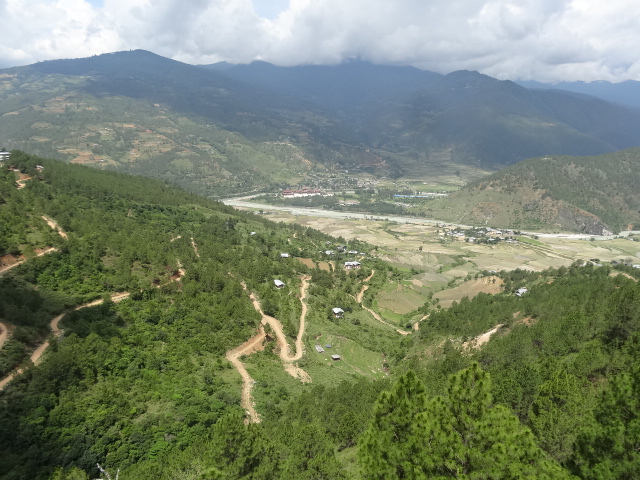
| View of small village in Phunaka |
 |
| The road to Tashidingkha |
 |
| Supporters of capitalism in the politics class |
 |
| Supporters of socialism in the politics class |
 |
| Getting ready to donate books |
 |
| 10th grade students at Tashidingkha |
 |
| Tashidingkha central building and location of morning prayer |
 |
| Tashidingkha cafeteria/ stage |
 |
| Tashidingkha basketball court |
 | |
|
 |
| Tashidingkha male dorm room |
 |
| Tashidingkha viewpoint (where we did most of our writing) |
 |
| Principles house |
Friday, August 9, 2013
Extended Update: Days 5- 17
After more than 10 internet-less days, we have finally returned from the
rural village of Punakha to Thimphu and the blog is up and running once again. When
we first arrived to Phunaka, we were greeted by verdant mountains and a wide
milk colored river that extended all the way to the famous Phunaka Tzong. It
was at this famous monastery, which once served as the military and political
capital of the country, that we were able to understand how important Buddhist
culture is for Bhutan. In a huge temple buried within this fantasy like valley,
it did not take a genuine belief in Buddhism to sense the deep spiritual
atmosphere we were submerged in, the giant Buddha and Guru Rinpoche (the
“second Buddha”) statues that towered over us confirmed that. After our three
hour trip, which took us over and along the side of a mountain, we reached the
center of Phunaka where we ate lunch at a local restaurant. Along with the
usual rice, curry, and tea, we were served a Bhutanese take on pasta. Upon
stepping into the restaurant and talking to the waitresses, it became quite
clear that we were no longer in Thimphu. Although communication was initially a
challenge, these waitresses seemed to have a greater desire to be helpful, as
they characteristically tilted their heads to the side every time they said
“okay”. After a quick rest we set
out once again, climbing yet another mountain to reach our final destination:
Tashidingkha Middle Secondary School. It was in this school that we were able
to work as teachers in 10th grade classrooms for ten days, covering
a wide range of topics. We had spent months developing a five day curriculum in
which each of us were divided into alternating groups of three and were
expected to come to class with enough resources and preparedness to properly
teach. Although our chief objective was the quality of each class, we also
wanted to offer subjects that are not normally taught in Bhutanese schools. We
did not want to teach the very same classes that their schoolteachers offered
because we thought it would hinder our relationship with the students and
conflict with the goals of the exchange program to provide the systematic trade
of new ideas. As a result, Kei taught
politics, Jun led technology classes, Kuba held lectures/ interactive
discussions on sports (and the culture that it is surrounded by), Nathan
introduced music in the form of an after school club and a real in class course,
James taught art, and I (Julian) led a philosophy course. So as we twisted up a
mountain to Tashidingkha in two separate vans, our minds were locked in a state
of anticipation. Although we all felt well prepared for class, we soon
understood all the independent variables of running a class, such as student
behavior and interest that could impede our ability to effectively teach. Luckily,
as our cars pulled up into the school, which lay nested within the trees on the
side of a mountain (with a stunning view too!), crowds of smiling students
greeted us. As soon as we stepped out of the car and began to interact, we were
all taken aback by the kindness and respect these Bhutanese students addressed us
with. It then became time to meet the host families we would be staying with so
we walked up a shaky rock staircase to the principle’s house. The house itself
was made up of one common room attached to a kitchen and a couple of bedrooms.
Soon the principle, his wife, and his two daughters (all of Nepalese descent)
greeted us along with the two other hosts, who were both male teachers that I had
worked with in the previous year. We sat down over a cup of tea and rice,
greeted one another, discussed our teaching schedules for the duration of our
stay, and identified which host each of us would be staying with. Jun and I
were hosted by the principle, Kei and Kuba by one of the two teachers, who
taught history and English and was named Sir Zangpo and Nathan and James by the
other teacher, who taught math and physics and was named Sir Drupka. After
finishing our meeting, Julian took everyone on a tour of the school. After
passing by many smiling and staring faces and meeting some of my old friends,
we noticed that there were dramatic differences between the students of Thimphu
and this school. Beyond the fact that these kids tended to be shorter and
thinner, their ages ranged dramatically from class to class (in one 10th
grade class it ranged from 16 to 25) and many of them came from
southern/eastern Bhutan and had generally darker skin than the people of
Thimphu. Even the landscape itself felt different as the valley of Phunaka felt
very empty in comparison to Thimphu and therefore much more isolated. So as the
sun struck the back of our necks at over 90 F, it seemed as though we had just
entered an alternate, or even historical, Bhutan. As we walked around, we noted the two floor hostiles and
classroom buildings that we saw. All the walls of these structures were made of
grey brick with wooden doors and railing that were painted in characteristic
Bhutanese dark red and orange. There was a two floor library/ computer (with no
internet of course!) building as well as an auditorium that served as the
dining hall as well as the location for dance competitions. Unlike our school (and most schools in
the US) the teachers travel from class to class instead of the students and
each building is separated and isolated from one another (so in the winter you
need to trot through snow to get from class to the dining hall… or the bathroom).
Students are assigned to a specific classroom and compete with one another in
various activities like bunks do in a sleep away camp. That is not to compare
these students’ schedules to sleep away camp, as it is, in some ways, far more
demanding than most American schools are. In Tashidingkha, wake time is 5:00am
for hostile/campus cleaning and early morning studies. This rigorous day (one
which we are quiet confident, in the US, would only result in armed rebellion!)
ends at 9:00pm – 10:00pm with nighttime studies although students usually only
go to sleep by 11:00pm. The school’s policy of discipline is also unnecessarily
harsh, as students would be regularly beaten for skipping class, prayer, or (and
especially) walking near the opposite gender’s dorm. Still, every time we
stepped out of our host family houses in the morning, we were greeted with the
same friendly and energetic smiles.
In our host
families, we ate traditional Bhutanese rice based dishes for almost every meal.
On occasion, we would have noodles or a Bhutanese take on western food, however
these dishes were so rare that we were generally confined to simple
combinations of rice and curry. Still we could not possibly complain as the
food in the student’s cafeteria was so nauseating (literally) that on the one
day we sat down to eat there, we were passionately warned not to so much as
touch the food on our plate. In our rooms, we each slept on a mattress (usually
without a bed), kept cool at night with a fan, and covered ourselves with a
sleeping bag liner to protect against insects. Although, for some of us, the
first few days of sleeping in our respected host family house was a period of
adjustment, over time we felt comfortable and well adapted to an entirely new
style of living. Still, we sacrificed a lot of the basic comfort that we had
back home as we were forced to burry ourselves under sleeping bags to keep bugs
out.
So on the first
full day of school, we began by officially donating 27 books (including The
Arabian Nights and the entire Harry Potter series) to Tashidingkha Middle
Secondary School during the morning assembly. We then introduced ourselves and
I briefly introduced our team and explained the program. After this, we walked
away from the school assembly platform and our teaching programs began. Since
each of us would meet with one specific classroom five times over the course of
the ten days, we understood the importance of properly introducing ourselves to
our class and guiding our class with some sort of progressive narrative that
has a clear start and ending. This meant that each of us needed to have a well
defined day to day lesson plan.
In Jun’s
technology class, he led a five day discussion/lecture about the rise of modern
technology and its societal impacts. This ranged from analysis of the effects
of nuclear energy to the power of the internet. One initial concern we had for
this course in particular was the ability of each student to fully understand
what Jun was talking about and although some students did not entirely connect
with what he was saying, a good portion of the class was extremely interested, with
some students even asking questions about renewable energy and supercomputers.
In Kei’s course,
he led a discussion, with me acting as a teacher’s assistant, about politics
and, specifically, what role the government should play in the lives of the
people. Initially, this class focused on exactly what a government is and why
it is created, however it soon shifted into a discussion about property and how
we use it to define our rights. Effectively, we discussed the Lockean idea that
our life is our own property and, not to over simply things, the government’s
job is simply to protect this conception of property. This then brought us to the
topic of rights, which we defined as manmade and enforceable moral values that
are agreed upon by a certain population. This immediately led us into a debate
about what freedom is, which the students agreed marked the elusive point
between absolute liberty (the ability to do ANYTHING one wants) and absolute
security (when the government controls everything for the purpose of safety).
The entire class agreed that freedom (the balance between these two ideas)
could not be simply defined as absolute security or liberty, however most of
them did not agree on what quantity of each essential idea constitutes true
freedom. The immediate result of this was a discussion, and inevitably a
debate, over the ideas of capitalism and socialism. Although some of the ideas
needed to be simplified for the purpose of the class, the students were able to
wage a passionate debate over these two ideas in context of the ideal role of
the government. Most of the students seemed to believe, to my delight, that
some additional government force is necessary in order to create a balanced
level of opportunity for all people, however a significant amount of students,
to Kei’s delight, were convinced that inequality of opportunity was a natural
component of society that the government simply should not tamper with. Every time we walked by a group of students
who participated in this class (and when we eventually left), we were met by
chants of “socialism!” or “capitalism” and even one or two subtle and drowned
out cries of “communism!” occasionally echoed in the distance.
Nathan created a
voluntary after school music class/ club that managed to draw a large number of
students each day. The class was dedicated to introducing a new genre of
popular American music each day. This ranged from country music to metal to
hip-hop to pop (the only genre the students seemed to have a familiarity with).
He brought in kazoos and rhythm sticks as part of numerous interactive music
activities (such as playing to a certain beat) and introduced music through an
amplifier (with unfortunately poor sound quality) by significant artists within
their respected genre. He even had students dance to each type of music as part
of a demonstration of the type of culture that each genre is followed by.
Beyond this, the students were encouraged to bring in their instruments and
perform in front of the class. Ultimately, music was very popular and the students
succeeded in expanding their appreciation of this basic human art form into
what was previously the unknown.
For James, his
art class focused on highlighting the role of art in American culture. Each
day, he addressed a specific artist in context of their style and innovativeness
and described how it directly reflected the specific movements and historical
events of the artists time period. The basis for this class was largely founded
on interactive activities (similar to music) so everyday, students would
attempt to recreate and mimic the style of a specific artist. This ultimately
culminated in splatter paint, where each student created a piece of work based
on the style of Jackson Pollock that was previously introduced in the class.
James ultimately connected each artist and their respective genres to his own
life and addressed it as a source of personal inspiration.
Kuba’s sports
class also (similar to James and Nathan) took place after school hours. The
curriculum was divided into two parts, with both an interactive and lecture
component. He would first introduce a specific sport that is famous in America
and discuss what makes it popular and the cultural the follows it. For example,
he discussed how basketball originated in the inner city of the US yet spread
worldwide to even the most remote and rural parts of Bhutan (for example). He
also commented on how sports can often act as an opiate that the people people
us to escape from reality. After this discussion, Kuba then took the students out
to a basketball court/field to play the sport that they had just discussed. He
had brought soccer balls, footballs, basketballs, and Frisbees with him, so he
was able to cover a wide range of sports despite Tashidingkha’s generally
lacking athletic resources. This was a very popular class, particularly amongst
the boys, and proved to be a very good means of interacting and connecting with
the Bhutanese students. Kuba separated his entire class into multiple competing
teams, which all of us exchange students joined, and forced us to break the
ice, understand, and cooperate with one another.
In my political philosophy
class, I led a series of discussions and lectures that revolved around the
conflicting ideas of perception and reality and how one informs the other. Initially,
I simply discussed the basic distinction between these two concepts and used
the example of someone wearing basketball clothes vs a real basketball player
to illustrate this idea. Effectively, I argued that everyone portrays
themselves in a certain way and actively seeks to alter the way others perceive
them by changing their appearance (makeup, clothes, est.). This idea was then
put into the context of entire countries and cultures as I equated politics,
film, music, and media in general as the primary means in which a country
changes the way foreigners (and even the native population) perceive it. I then
placed this thought into the more familiar backdrop of Bhutan and described how
Gross National Happiness (GNH) is often used as a selling point or a means of
fixing an image of the country to foreigners. I discussed how the vast majority
of people who have heard about Bhutan have only heard it in the context of GNH
and therefore trick themselves into the irrational belief that everyone in
Bhutan is happy, something the students of Tashidingkha flatly denied. Eventually, I was able to take these basic ideas and lead the class through various lectures about the writings of great western political philosophers such as Karl Marx and John Locke. After the first day of introductory content, the students became extremely passionate about the issues that we discussed. This was very satisfying, as this was a subject that had never been taught in any Bhutanese High School, yet the students still developed their own passionate opinions on the ideas we discussed. This culminated in many organized and, even more, spontaneous debates that often continued long after the school day had finished. On the final day of class, I tied the entire notion of perception and reality, which had been the underlying theme throughout the class, together through
Plato’s famous Allegory of the Cave, which describes the intrinsic relationship
between these two philosophical concepts. Through the use of visual images and
representations, the students understood the idea behind Plato’s argument and
used it as a basis to describe importance of education through physical
experience to liberate the individual from their “chains”.
Despite our heavy
workload, we managed to find the time to explore our surroundings, going on a
relatively strenuous hike to a nearby monastery that rested on the top of a
mountain. Tremendous visual beauty encompassed us throughout the trip as green
leaves shined brightly in our eyes and a rainbow pierced through the clouds
down into the trees.
When we reached
the monastery at the top of a mountain, we were surprised to see the small farm
that rested on a nearby ledge, which we soon proceeded to climb. We picked
apples, pears, and, cucumbers to wash and peel for our mid-hike snack.
Beyond our work
as teachers in classrooms, we also sat in as teacher’s assistants for real Tashidingkha
classes. This gave us the opportunity to witness classes in action and
critically understand why certain students struggled in the subjects that they
did. One concern that immediately struck us was that English is used as the
language of instruction amongst a body of people who are far from fluent in the
language and as a result, a science or math class becomes a greater test of
English than a real English class. This explains why science and math classes,
are home to the largest number of failing students while English, seemingly
paradoxically, is the school’s strongest subject. The direct result of this
issue was teacher frustration as many of them would simply not show up to class
and neglect their duties and every given opportunity. Even in the English and
history classes (the school’s strongest subjects) the students often struggled
to grasp the material being taught to them. In 10th grade, students
read The Giver by Lois Lowry (a book we all read in 6th grade) and
although the language is not incredibly complex, the themes of the book are so
abstract that only a very small group of select students (who all
coincidentally came to Tashidingkha from Thimphu) actually understood the
novel. Kuba actually sat in on one of these English classes and attempted to
explain what was happening in each chapter more thoroughly. Still, most of the
students lacked the basic English ability required to understand Kuba’s more
complex analysis of the book.
Through these
experiences, we were able to gain first hand knowledge of the difficulties the
teacher’s faced when attempting to teach their students. Beyond this, because
there is no Internet in Tashidingkha and the quality of the available textbooks
are so poor, many teachers simply had to guess or estimate facts and historical dates
because they lacked the resources to ensure they were entirely accurate. Even some of the
more remote schools in Bhutan, many of them have some Internet or common point
of reference that teachers can use. Tashidingkha was unfortunately unique in
the respect that they had none of it.
Still, all of us
agree that this was an absolutely eye opening and incredible experience and as
we conversed and laughed with the students of Tashiginkha, we began to
formulate a unique understanding of the Bhutanese people and their culture, one
that we had not yet found in the early parts of our trip. So as I addressed all of Tashidingkha’s students and staff for the last time, I thanked them all for the hospitality and officially announced Tashidingkha as a
primary partner in the Bhutan-US exchange program. I closed by reading off a
poem about the importance of education for creating a more informed and
idealistic citizen. As we finally rode away from the school, we waved
goodbye to our friends and set our sights toward Thimphu and schools that we
would soon be visiting, we sat in anticipation of a totally new experience in a
place with a seemingly alternative conception of Bhutanese culture.
Subscribe to:
Posts (Atom)